Trial of Implementing a Binary-Based AI Model to Support Modern Agriculture
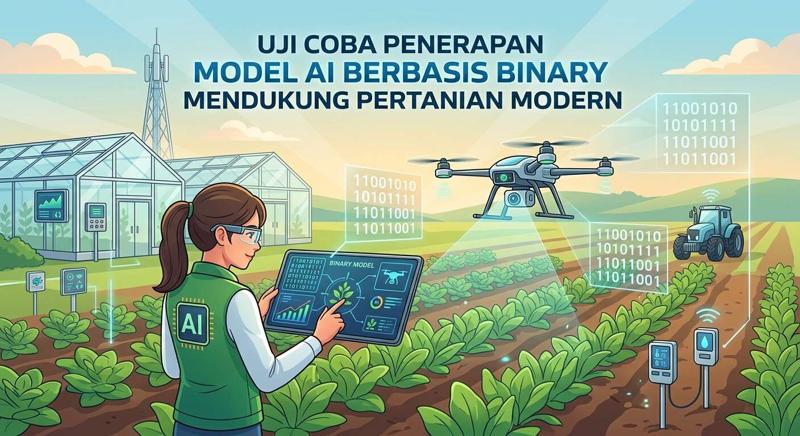
The development of Artificial Intelligence (AI) technology has brought changes in various fields, including the agricultural sector. Modern agriculture no longer relies solely on farmers' experience in determining watering times, monitoring plants, or managing land. Data originating from sensors, digital devices, weather and environmental conditions can begin to be utilized to help produce more measurable decisions. One approach that can be tested in developing AI-based agriculture is a binary-based AI model or binary classification.
The binary-based AI model is a classification method that produces two categories of output. In simple terms, these results can be represented using the numbers 0 and 1. These numbers can then be given meaning according to system requirements. For example, the number 0 can indicate that the condition of the plant is still normal, while the number 1 indicates that the plant requires further inspection or action.
This concept is simple enough to be implemented as an initial stage of agricultural digitalization. The system does not have to directly provide very complex analysis. By determining two clear conditions, AI can help farmers obtain information that is easier to understand.
Binary AI Implementation Concept
In its application, the binary model requires input data or features. This data can include soil moisture, temperature, air humidity, light intensity, rainfall, plant age, plant type, as well as historical growth data.
The data is then used to train the model to recognize certain patterns. For example, if the system goal is to determine watering needs, the dataset can have two labels, namely 0 for "does not require watering" and 1 for "requires watering".
The model then learns the relationship between various parameters and actual conditions in the field. Once the training process is complete, the model can receive new data and provide predictions based on the patterns it has learned.
It is important to understand that binary does not mean that the entire agricultural system only uses two types of data. The system can use many variables as input, but the final results are classified into two categories.
Trial Stage
Trials can be started on a small scale on one area of land. The first step is to determine the problem you want to solve. An example is detecting whether a plant needs watering or inspection.
Furthermore, data is collected periodically. Soil moisture sensors can be used to determine the condition of water in the soil. Temperature and humidity sensors can also be used as supporting data.
After the data is collected, the data cleaning and processing process is carried out. Incomplete, duplicate, or inappropriate data needs to be checked before being used for training.
The data is then labeled based on actual conditions. After that, the dataset is divided into training data and testing data. The model is trained using training data, then tested using data that has never been used in the training process.
Benefits for Agriculture
The application of binary AI models can help simplify the decision-making process.Prediction results can be displayed in an easy-to-understand form, for example “Normal” or “Action Required”.
The system can also help farmers monitor large areas of land. Instead of carrying out inspections evenly every time, farmers can get information about parts of the land that need attention.
In addition, the data collected can become a digital record that is useful for evaluation. Farmers can see changes in land conditions over time and compare them with production results.
Implementation Challenges
Implementing AI in agriculture has a number of challenges. One of them is data quality. AI models require sufficient and representative data to be able to produce good predictions.
Environmental conditions may also change. Models trained on certain conditions may not necessarily produce the same results when used on different soil types, plant varieties, or weather conditions.
Therefore, the model needs to be tested directly in the field. Prediction results also need to be compared with farmers' observations so that the level of suitability can be known.
Conclusion
Trialing binary-based AI models can be one of the first steps in implementing artificial intelligence technology in the agricultural sector. By using various data as input and producing decisions in two categories, the system can help simplify agricultural information.
Implementation can start from simple problems such as watering needs, plant inspections, or risk identification. With consistent data collection and regular evaluation, the model can continue to be developed according to field needs.
AI technology is ultimately not intended to replace the role of farmers, but to become a tool that can support data-based decision making.