Binary-Based AI Trial for Risk Identification on Agricultural Land
Agricultural activities face various risks that can affect plant growth and production results. Changes in weather, inappropriate soil moisture, extreme temperatures, environmental conditions, and plant disturbances are some of the things that need to be considered during the cultivation process.
Farmers usually carry out monitoring based on experience and direct observation. This approach has an important role, but technology can be used to help carry out monitoring in a more structured manner.
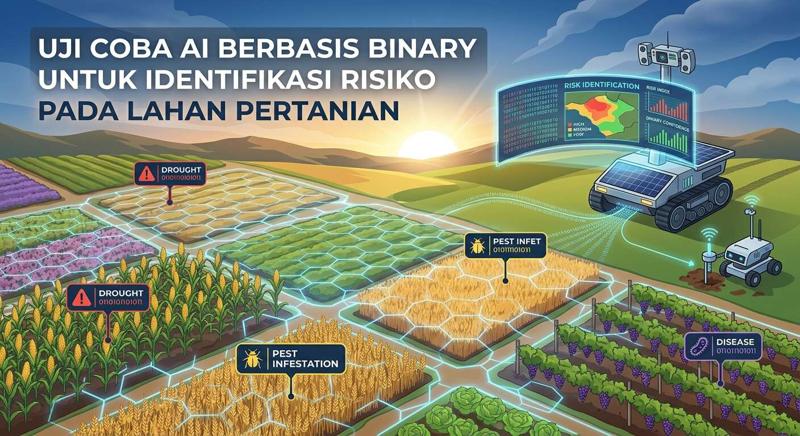
Binary-based Artificial Intelligence could be one of the approaches being tested. The system can be used to classify whether a condition indicates a risk or not.
Risk Detection Concept
In the binary system, risk can be divided into two classes.
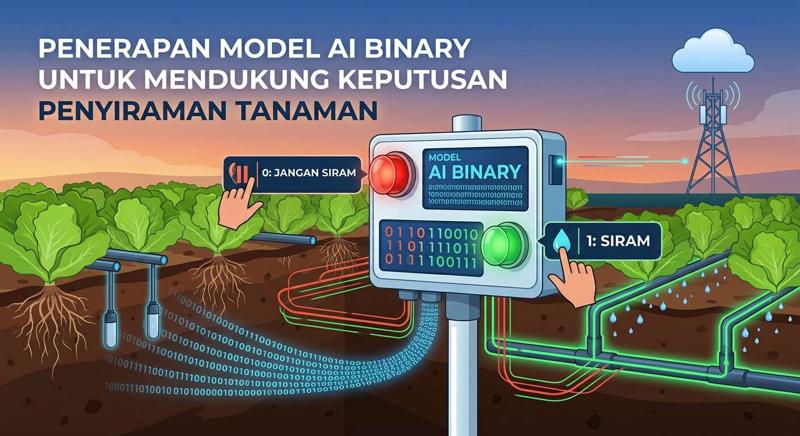
A value of 0 can be used to indicate “undetected risk”, while a value of 1 is used to indicate “detected risk indication”.
Both labels must be determined based on the system objectives. If the system is intended to detect plant conditions that require inspection, then the data must be labeled based on relevant observations.
The model then learns patterns from the data.
Agricultural Data Sources
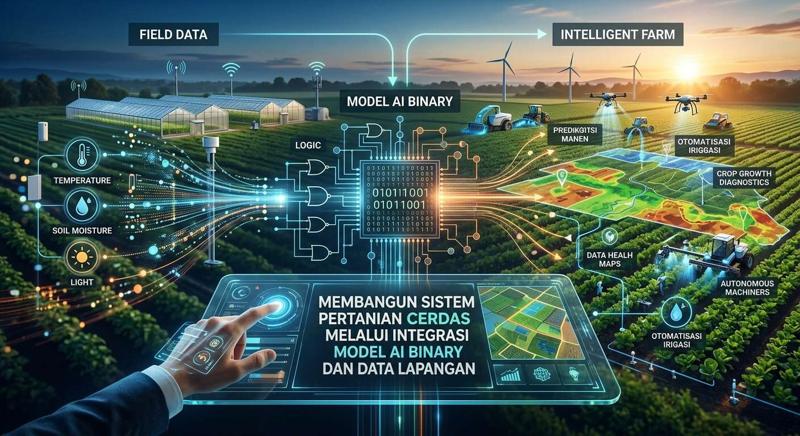
The system can use various data sources. Soil moisture sensors can provide information about water conditions in the soil. Temperature sensors can indicate temperature conditions. Rainfall data can be used to determine environmental changes.
In addition, historical records can also be used. These notes can contain planting time, plant conditions, fertilization, watering, as well as disturbances that have occurred.
Data from several sources can be combined to form a more complete dataset.
However, each variable used must have a clear reason. Using too much irrelevant data can actually complicate the model development process.
Data Collection and Labeling Stage
The initial stage of system development is collecting data. Data is collected under different conditions so that the model can recognize environmental variations.
After the data is available, labeling is carried out. Data that does not show any indication of risk is given a value of 0, while data that shows a risk condition is given a value of 1.
Labeling must be done carefully because the quality of the label will affect the model's learning results.
If possible, the label can be verified through direct observation by the farmer or someone who understands the condition of the plant.
Model Training Process
The ready dataset is then divided into training data and testing data. Training data is used to build the model, while testing data is used to determine the model's ability to carry out classification.
The learning model looks for relationships between input features and labels.
Once training is complete, the model can be used on new data. The system then produces a value of 0 or 1.
The results can be displayed via the dashboard or notification system.
Early Warning System
One use of binary AI is as an early warning system. When the model produces a value of 1, the system can provide a notification to the farmer.
The notification does not have to directly state that the plant is definitely damaged. The system can use information such as "Risk indication detected, carry out field inspection".
This approach is important because AI has the possibility of making prediction errors. Human inspection is still needed to confirm actual conditions.
Performance Evaluation
Evaluation can be done using a confusion matrix. The confusion matrix shows the number of correct and incorrect predictions in each class.
From this data accuracy, precision, recall and F1-score can be calculated.
However, evaluation figures alone are not enough. The model also needs to be tested in different field conditions. A model that performs well on a particular dataset may not necessarily give the same results when used in a different location.
Therefore, field testing needs to be carried out continuously.
Limitations of Binary Models
The binary model simplifies agricultural conditions into two categories. In fact, agricultural risks can have various levels.
For example, plants can be in normal conditions, experiencing mild stress, experiencing moderate stress, or experiencing conditions that require immediate treatment.
If the system requires more detailed classification, a multi-class approach can be considered. However, binary classification can still be an initial stage because it is simpler to test and evaluate.
Conclusion
Binary-based AI can be used as an approach to identify indications of risk on agricultural land. The system can utilize sensor data and historical data to produce simple classifications.
This application has the potential to help farmers carry out more targeted monitoring. When the system detects indications of risk, farmers can carry out further checks.
Trials still need to be carried out in stages by paying attention to data quality, land characteristics and plant conditions. With this process, AI models can continue to be developed to better suit agricultural needs.